The useful takeaway
Match the tool to a specific decision, check its limits, and ask for evidence that survives review before expanding its role.
This Friday’s briefing looks beyond general-purpose model launches. A document-review service, a family of forecasting models and an expanded external-evaluation arrangement offer three different ways to think about business adoption: what work can a tool help with, how do we test it, and what evidence should we expect from its supplier?
We scanned October 14–16, 2026, continuing from Wednesday’s research cutoff at 13:50 UTC on October 14 through 16:03 UTC on October 16. Google’s October 14 announcement is newly covered here; its page does not give an exact release time. The other two announcements are dated October 15. These are source-based findings and PraoAI’s recommendations, not results from our own product benchmarks or client deployments.
1. Google opens Deep Review for technical documents
Google Research announced public access to Deep Review on October 14. The service is designed to examine complex documents for issues such as inconsistent reasoning and unsupported claims. Google says access is worldwide, with two complimentary document reviews per user each week and higher limits through a Gemini API key. Initial input formats are PDF and plain text; multi-file support is described as coming soon.[1]
There is a material distinction between model training and document storage. Google says uploads are not used to train or improve its models, but are stored for one year for display in the interface. Check the applicable terms and your document-handling requirements before uploading business material. A promise about training does not mean a document disappears after processing.[1]
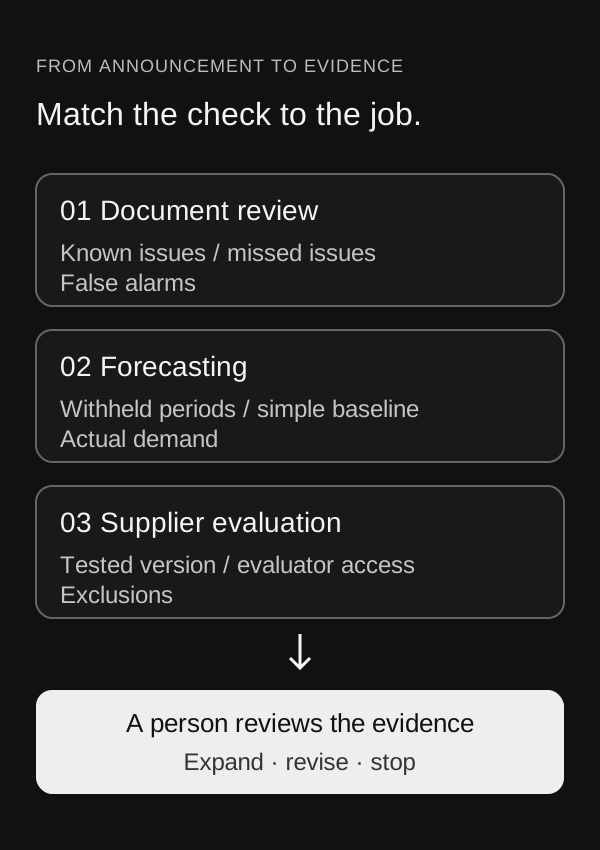
Our suggested first test is a non-confidential technical proposal with a known contradiction: for example, one section promises a weekly update while another assumes a daily feed. Have a reviewer record the issues before running the tool. Then count useful findings, missed issues and false alarms, including the time needed to verify each suggestion. This is an illustrative test, not a claim about what Deep Review will detect.
Teams preparing specifications or internal proposals may find this worth exploring. Keep a person responsible for accepting edits. A polished critique can introduce new mistakes, and a clean report should not be treated as proof that every claim is correct. Start with a document whose quality your team can already judge.
2. Mistral releases models built for forecasting
On October 15, Mistral introduced Timestral, a family of time-series models in four sizes, from 5 million to 209 million parameters. It forecasts numerical sequences, including related series and uncertainty ranges. Mistral says inference can run on CPUs and has published a repository for trying the models. Its performance comparisons are vendor-reported; we have not reproduced them.[2]
The model documentation labels Timestral 1.0 as Public Preview under a Modified MIT license. It lists support for up to 32,000 time steps, historical explanatory inputs and inputs known in advance. Treat preview status and the actual license terms as part of the deployment decision, rather than assuming a downloadable model is a supported production service.[3]
A useful business experiment could forecast incoming support tickets to help plan staffing. Keep the latest period out of the inputs and compare the forecast with what actually happened. Compare against a simple baseline, such as the same weekday in the previous week. Use several historical cutoffs so one unusually easy period does not decide the result. This is our proposed evaluation design, not a measured Timestral result.
Take particular care with information that would not have existed when the forecast was made. A planned promotion can be a legitimate input; the final sales total from that promotion cannot. Record errors in business terms, too: underestimating a busy day and overstaffing a quiet day have different consequences. A better average score alone may not improve the decision you care about.
3. Anthropic expands access for independent evaluators
Anthropic said on October 15 that six staff from METR, an independent evaluation nonprofit, have received access to internal systems broadly comparable to its own risk-assessment teams. The announcement describes exclusions, including customer information, privileged material and model-architecture information. It also says Anthropic cannot veto METR’s publications, while retaining narrowly defined redaction rights that METR can discuss publicly.[4]
This is an announcement about access and evaluation arrangements, not a new finding that a particular model or business deployment is safe. Anthropic describes other evaluator partnerships with different access and publication rights. An evaluator’s name on a partnership announcement therefore tells you less than the scope of the work and the eventual report.[4]
For a business choosing an AI supplier, our recommendation is to ask concrete questions: which version was examined, what could the evaluator inspect, which failures were tested, and what remains outside the assessment? Keep those answers alongside your own acceptance checks. External work can inform purchasing and deployment decisions without replacing tests of your integrations, inputs and approval process.
Choose the next test from the work you already have
Our reading of these developments is that the evaluation method needs to fit the job. Document review needs an issue list that a person can verify. Forecasting needs historical comparisons without future information leaking into the inputs. Supplier assessment needs a clear account of what was examined. Using one generic prompt or leaderboard score for all three would hide the differences that matter.
Pick one recurring decision and write a short acceptance note before trying another tool. Name the input, the reviewer, the comparison and the condition that would make you stop. Include setup and review time in the cost. If the first result looks promising, repeat the test on a difficult example before connecting the tool to live actions.
Keep the initial outcome small: a reviewed document, a forecast compared with actual demand, or a supplier evidence checklist. Record both the successful cases and the failures. That gives the next person enough information to decide whether the experiment should continue, instead of leaving them with a persuasive demonstration and no basis for comparison.
Sources & further reading
Sources reviewed October 16, 2026. Examples and recommendations are PraoAI Labs’ analysis; capabilities and services may change.
- Analyzing technical documents with Deep ReviewGoogle Research · October 14, 2026
- Introducing TimestralMistral · October 15, 2026
- Timestral 1.0: preview status and model detailsMistral documentation · reviewed October 16, 2026
- An update on independent evaluatorsAnthropic · October 15, 2026
- AI agents this week: stronger models, clearer permissionsPraoAI Labs · related briefing · October 14, 2026
- Five everyday workflows worth automating firstPraoAI Labs · practical background
Put the idea to work.
We can help turn a workflow or product idea into a clear scope and a useful first version.
Explore workflow & systems integration